CapCut AI Video Generator – Complete Guide to Create AI Videos Faster (2026)
I still remember the first time I opened CapCut just to “test” the AI video tool out of curiosity. Within fifteen minutes I had a full social media clip ready, with a voiceover, captions, and matching background music, something that used to take me almost two hours in a regular editor. That one session changed how I plan content every week.
If you create content for YouTube, Instagram, TikTok, or even client work, you’ve probably heard people talk about the CapCut AI video generator and wondered whether it’s actually worth your time or just another overhyped AI feature. I’ve used it almost daily for scripts, faceless videos, and quick product clips, so in this guide I’m sharing everything I’ve learned from real use, not just theory.
By the end, you’ll know exactly what this tool does, how to use it step by step, where it shines, where it struggles, and how to get noticeably better results than most beginners do on their first try.
What Is CapCut AI Video Generator?
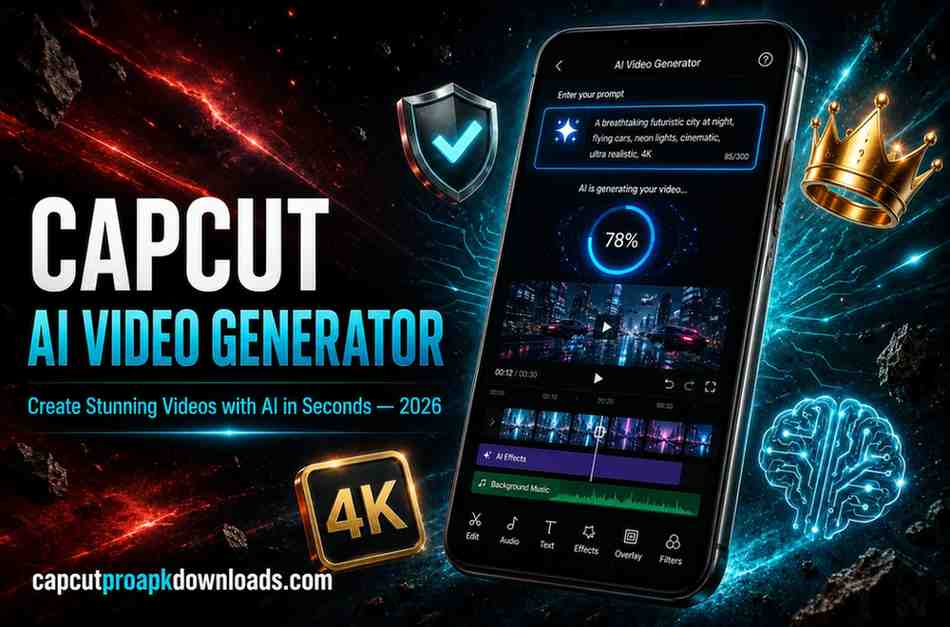
This AI video tool is a built-in feature inside CapCut that turns a text script, a single image, or even a rough idea into a finished video automatically. Instead of dragging clips on a timeline for hours, you type what you want, and the AI handles scene selection, pacing, voiceover, and captions for you.
What makes it different from a basic editor is that it doesn’t just cut and arrange footage you already have. It actually generates new visuals, voices, and avatars from scratch when you don’t have any raw footage at all, which is exactly why faceless creators and small marketing teams have adopted it so quickly across India, Pakistan, Bangladesh, and the wider South Asian creator community.
How Does This AI Video Tool Work?
In simple terms, the tool reads your input (a script, a topic, or an image), breaks it into scenes, and then matches each scene with relevant visuals from its media library or AI-generated clips. At the same time, it generates a natural-sounding voiceover and syncs captions automatically.
I’ve noticed it pays close attention to pacing too. When I tested a 60-second script, it didn’t just throw random clips together; it timed scene changes with the rhythm of the voiceover, so the video never felt choppy or rushed.
Who Should Use This AI Video Tool?
Honestly, almost anyone who creates video content regularly. From my own experience helping smaller creators get started, here’s who benefits the most:
- Faceless YouTube and TikTok creators who don’t want to appear on camera
- Small business owners in India and Pakistan who need quick product or service videos without hiring an editor
- Students and freelancers who need fast explainer or presentation videos
- Marketing teams that need to test multiple ad variations without a full production setup
- Beginners who have zero editing experience but still want professional-looking output
Is CapCut’s AI Video Tool Free to Use?
Yes, the core AI video generator features are free to use, which is honestly one of the biggest reasons it’s so popular in South Asia, where paid software subscriptions aren’t always practical for every creator. CapCut Pro does offer a Pro plan with extra perks like higher export limits and premium assets, but I’ve personally created full videos, including AI Avatars and AI voiceovers, without paying anything.
Key Features of CapCut AI Video Generator
This is where the tool really earns its reputation. I’ve tested almost every feature listed below personally, so I’ll explain each one the way I’d explain it to a friend, not a textbook.
Script-to-Video Generation
You paste or write a script, and the AI converts it into a fully visual video with matching scenes, transitions, and a voiceover. I use this the most for faceless content because it removes the need to hunt for stock footage manually.
Image-to-Video Creation
Upload a single image, and CapCut animates it with subtle movement, transitions, and depth effects. I’ve used this for product photos when I didn’t have video footage of the item, and the output looked far more dynamic than a static slide.
AI Avatar Generator
This feature creates a talking digital presenter that lip-syncs to your script. You can pick from the built-in avatar library or generate one based on an uploaded photo. It’s particularly useful when you want a “human face” on screen without actually recording yourself.
AI Voice Generator
CapCut’s voice generator supports multiple languages and accents, including options that sound natural for Hindi, Urdu, and English-mixed scripts, which is a big deal for South Asian creators making bilingual content. It also automatically removes filler sounds like “um” and “uh” from generated narration.
AI Expand for Longer Scenes
If a generated clip feels too short for your platform’s format, AI Expand stretches or reframes the scene intelligently instead of just looping it, so the video still fits TikTok, Instagram, or YouTube aspect ratios without looking stretched or repetitive.
AI Templates
CapCut offers ready-made AI templates for common formats like news-style videos, educational explainers, and product showcases. Instead of designing a structure from zero, you select a template and feed in your own content.
Smart AI Editing
Once your video is generated, the AI suggests cuts, transitions, and pacing fixes automatically. I often tweak two or three of these suggestions rather than rebuilding scenes manually, which saves a lot of editing time.
Scene-by-Scene Video Generation
For longer videos, you can build and adjust each scene individually, changing the avatar, voice, or background per scene, which gives you far more creative control than a fully automatic one-click output.
Built-in Media Library
CapCut includes a large internal library of stock visuals, music, and sound effects, so even if the AI-generated scene isn’t perfect, you can swap it instantly without leaving the app or searching external stock sites.
One-Click Video Export
After editing, you export directly in your chosen resolution and aspect ratio, with presets already optimized for YouTube, Instagram Reels, and TikTok, which removes the guesswork around correct dimensions.
How to Use This AI Video Tool? (Step-by-Step)
Here’s the exact process I follow almost every time I create a new AI video in CapCut, whether on mobile or desktop.
Step 1 – Open CapCut
Launch the CapCut app or visit CapCut’s web editor, then log in to your account so your projects and media history save automatically.
Step 2 – Choose AI Video Generator
From the homepage, select the AI video generator or “AI video maker” option, depending on whether you’re using script-to-video, image-to-video, or the instant AI video creator.
Step 3 – Enter Your Prompt or Script
Type your topic, paste your full script, or let CapCut’s AI generate one for you based on a short idea. I usually write my own script when I want full control over the message and tone.
Step 4 – Select Video Style & Settings
Choose a visual style (realistic, cinematic, cartoon, or 3D), pick your aspect ratio based on the platform you’re posting to, and set the approximate video length.
Step 5 – Generate the AI Video
Click generate, and CapCut will process your script into scenes, add a voiceover, and assemble the rough cut. This step usually takes a minute or two depending on video length.
Step 6 – Edit with AI Tools
Review the generated video and make adjustments, change the avatar, swap a scene, edit captions, or replace background music, until it actually matches your vision instead of settling for the default output.
Step 7 – Export in High Quality
Once you’re happy with the result, export the video in HD or higher resolution, choosing the correct format for the platform you’re publishing to.
Different Ways to Generate AI Videos in CapCut
The features above explain what each tool does. This section is about which one to pick depending on what you’re starting with and how much control you want over the final script.
Text-to-Video
Pick this when you only have a rough idea and no time to write anything. You hand over a one-line topic, and CapCut’s AI both writes the script and builds the video, which is the fastest path from zero to a finished clip.
Script-to-Video
Pick this when you already have a written script and want to keep full control over the exact wording and message. CapCut focuses purely on visuals, voiceover, and pacing around the script you supply.
Image-to-Video
Pick this when your starting point is a single photo rather than text, for example a product shot or a portrait you want to bring to life with motion and transitions.
AI Avatar Videos
Pick this when you want the script delivered by a “face,” for tutorials, announcements, or personal-brand content, without ever turning on a camera yourself.
AI Presentation Videos
Pick this when your content is structured around talking points rather than a narrative script, which suits business updates, training material, or classroom content.
Best Use Cases of This AI Video Tool
From my own projects and ones I’ve helped friends with, here’s where this tool genuinely performs well.
YouTube Videos
Faceless YouTube channels use script-to-video and AI avatars to publish consistently without ever appearing on camera, which is one of the fastest-growing content styles across South Asia right now.
TikTok Videos
Quick, trend-based clips benefit from CapCut’s fast turnaround between idea and finished export, especially with built-in vertical aspect ratio presets.
Instagram Reels
The same AI-generated content can be repurposed for Reels almost instantly, since CapCut already supports the correct format and length for the platform.
Facebook Videos
Local businesses across Pakistan and India use AI-generated promotional clips for Facebook pages, where short, clear videos consistently outperform plain text posts.
Marketing Ads
Small agencies and freelance marketers test multiple ad variations quickly using AI video generation, instead of booking expensive shoots for every version.
Product Promotions
E-commerce sellers turn product photos into short promotional clips using image-to-video, which I’ve personally used for listings that had no existing video content.
Educational Videos
Teachers, coaching centers, and online tutors create explainer videos using AI avatars and presentation-style templates, especially useful for remote or hybrid learning setups.
Business Presentations
Instead of a plain slide deck, business owners convert key points into a narrated AI video presentation, which feels more engaging in client pitches and internal training.
Personal Projects
Vloggers, students, and hobbyists use the tool for quick personal content, recap videos, or even assignment submissions that need a polished video format.
Benefits of Using This AI Video Tool
Saves Time
What used to take hours of manual editing now takes minutes from script to export, which has genuinely changed how often I’m able to publish content.
Beginner-Friendly Interface
You don’t need prior editing experience. The interface guides you step by step, and most first-time users I’ve introduced to it figured it out within a single session.
AI Automation
Scriptwriting, voiceover generation, scene matching, and caption syncing all happen automatically, removing the most time-consuming parts of traditional video production.
Professional Video Output
The final videos look clean and well-paced, often comparable to what a junior editor would produce manually, especially after a small round of manual polish.
No Advanced Editing Skills Required
You can produce a complete, publishable video without ever touching a traditional timeline-based editing workflow if you don’t want to.
CapCut AI Video Tool: Pros and Cons
| Advantages | Limitations |
| Free core features, no mandatory subscription | AI-generated scenes occasionally don’t match the script’s exact tone |
| Fast turnaround from script to finished video | Heavier projects can take longer on slower internet connections |
| Multiple input methods: text, script, or image | Free plan has limits on export resolution and premium assets |
| Strong multilingual voice support (Hindi, Urdu, English) | Avatar lip-sync isn’t always perfect with complex scripts |
| Works on both mobile and desktop | Best results still need a manual review pass before export |
Tips to Get Better Results with This AI Video Tool
These are small adjustments I picked up after a lot of trial and error.
Write Better AI Prompts
Be specific about tone, audience, and key message in your script or prompt. Vague prompts usually produce generic, forgettable visuals.
Choose the Right Aspect Ratio
Always match your aspect ratio to the platform before generating, vertical for Reels and TikTok, widescreen for YouTube, since changing it after generation can distort scenes.
Use High-Quality Images
For image-to-video projects, sharper, well-lit images animate far more smoothly than blurry or low-resolution ones.
Edit AI Output Before Export
Never publish the first generated draft. I always review pacing, captions, and voiceover tone before exporting, and it makes a noticeable difference in final quality.
Combine AI Tools for Better Videos
Mixing AI avatars with your own background music choice, or combining script-to-video with manual scene swaps, usually produces a more personalized result than relying on one feature alone.
Common Problems and Their Solutions
AI Video Not Generating
This usually happens due to a weak internet connection or an overly long script. Try shortening your input or switching to a more stable network.
Slow Processing
Longer videos with multiple avatars or high-resolution settings naturally take more time. Closing other heavy apps while generating can speed things up.
Export Failed
This is often linked to storage space or app updates. Clearing cache and updating CapCut to the latest version usually resolves it.
Poor AI Results
If the output feels mismatched, rewriting your script with clearer, simpler sentences almost always improves how accurately the AI matches scenes.
Watermark Issues
Free exports sometimes include a small watermark depending on your settings; checking your export preferences before generating avoids this.
CapCut AI Video Tool vs Traditional Video Editing
Speed
AI generation is dramatically faster, producing a rough cut in minutes compared to hours of manual timeline work in traditional editing.
Ease of Use
Traditional editing demands familiarity with timelines, layers, and transitions, while the AI generator only needs a script or image to start.
Customization
Traditional editing still wins for highly specific, frame-by-frame creative control, but CapCut’s scene-by-scene AI editing closes much of that gap.
Best Choice for Beginners
For anyone new to video creation, the AI generator is clearly the better starting point, since it removes the steepest part of the learning curve.
Is This AI Video Tool Safe to Use?
Privacy
CapCut requires standard account permissions for media access, similar to most editing apps, and you control what photos or videos you upload for processing.
Data Security
Uploaded content is processed to generate your video output, and CapCut’s terms of service outline how this data is handled, which is worth reviewing if you’re working with sensitive client material.
AI Content Usage
Videos you generate are yours to use commercially under CapCut’s standard terms, though it’s always good practice to review current licensing terms if you’re publishing branded or client work.
FAQ‘s
What is CapCut AI Video Generator?
It’s a built-in CapCut feature that converts text, scripts, or images into finished videos automatically, handling visuals, voiceover, and captions without manual editing.
Is CapCut’s AI video tool free?
Yes, the core features are free to use, with an optional Pro plan available for extra assets and higher export limits.
Can I create videos from text?
Yes, the text-to-video and script-to-video options both let you generate a complete video starting from written content alone.
Can I generate videos from images?
Yes, the image-to-video feature animates a single photo into a moving scene with transitions and effects.
Does it support AI avatars?
Yes, CapCut includes an AI avatar generator with multiple digital presenters, plus the option to create a custom avatar from your own photo.
Can I edit AI-generated videos?
Yes, every AI-generated video can be edited afterward, including swapping scenes, changing voiceovers, and adjusting captions before export.
Is CapCut available on mobile and desktop?
Yes, CapCut works on Android, iOS, desktop, and through its web-based editor, so you can generate AI videos from almost any device.
Which export quality is supported?
CapCut supports exports up to HD and higher resolutions depending on your plan, with presets ready for major social platforms.
Is it suitable for YouTube and TikTok?
Yes, it includes ready aspect ratio presets for YouTube, TikTok, Instagram Reels, and Facebook, making cross-platform publishing straightforward.
What are the best prompts for AI video generation?
Clear, specific prompts that mention tone, audience, and key message produce noticeably better results than vague, one-line topic ideas.
Conclusion
After using the CapCut AI video generator across dozens of real projects, from product promos to faceless YouTube content, I’d say it’s one of the most practical free AI video tools available right now, especially for creators across India, Pakistan, and the rest of South Asia who need fast, professional-looking videos without expensive software or a full production team. It’s not flawless, and a quick manual review before export always improves the final result, but for speed, accessibility, and overall output quality, it genuinely delivers on what it promises.